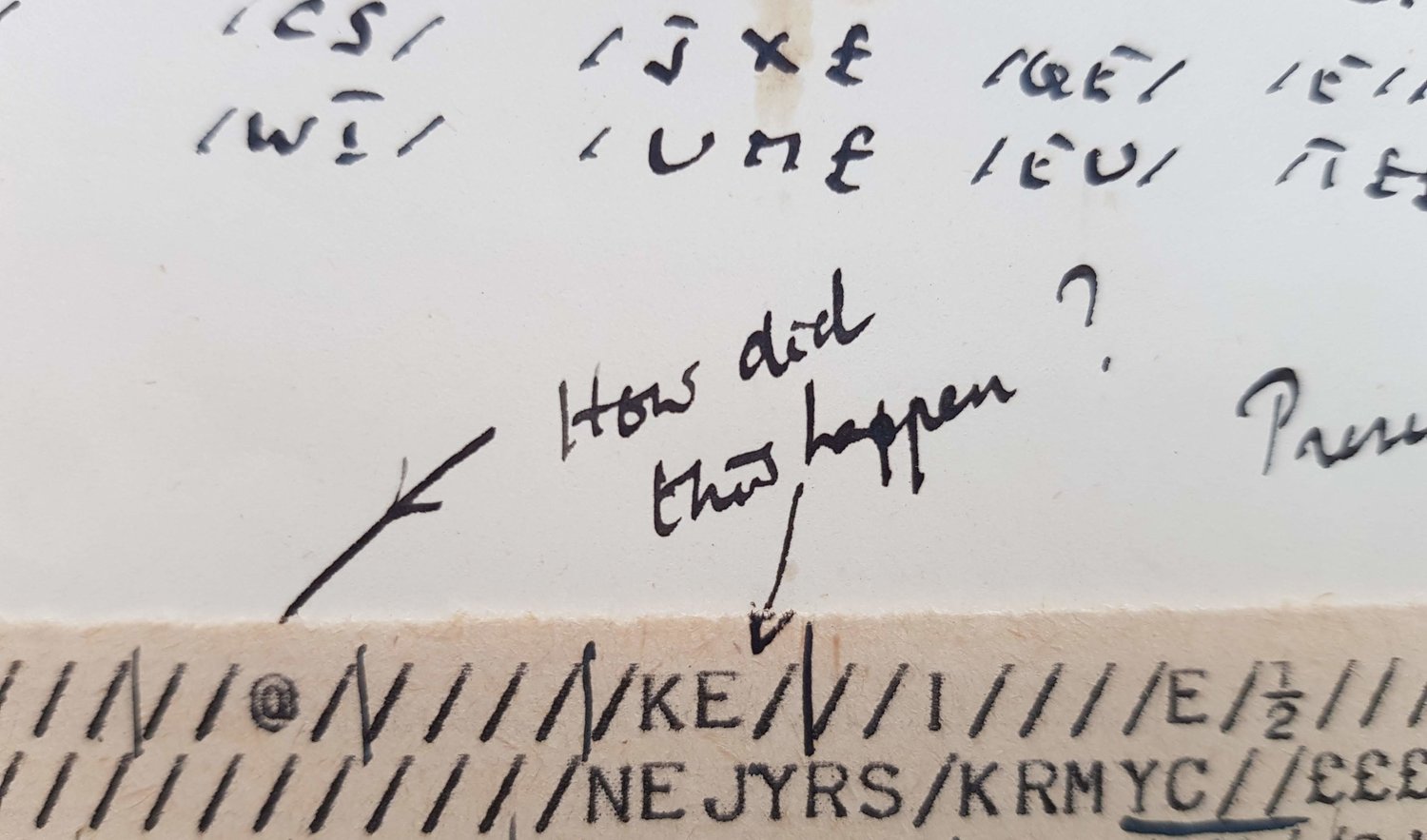
A previously unseen and very slightly interesting letter from Turing to Philip Hall, his teacher, friend and colleague at King’s and Bletchley Park. It was written during the couple of years when Turing had departed Bletchley Park to work on the Delilah speech encryption project Delilah. (It’s my theory that it was the analyses of the nonlinear instabilities of those Delilah electronic circuits that inspired Turing’s mechanism for the model that became The Chemical Basis of Morphogenesis). One point of interest for some might be the group theory problem Turing raises. It is almost certainly the problem Hodges mentions in note 5.14 of ATTE and corresponds to the manuscript On Permutation Groups.
For me, more interesting is the social context in which Turing addresses his old friend as ‘Philip’. Turing’s first letter to Hall, announcing his first paper just a year after graduating, is topped and tailed ‘Dear Mr Hall’ and ‘A.M. Turing’, the near universal convention between student and don. A year later the address has become ‘Dear Hall’, the near universal convention between don and don. For example, Turing also carried on a long correspondence with Albert Ingham, who had been his other teacher at King’s, which always remained as ‘Turing’ and Ingham’ (see this example). But with Philip Hall, Turing progressed to the much more intimate ‘Philip’ by about 1937 and that’s where it stayed. I had already seen these gradations of emotional intimacy from the Hall letters in the King’s archive and their absence in the Ingham archive in Trinity but it is interesting to see them confirmed here.
The lectureship is slightly mysterious. Max Newman’s obituary says Turing was offered one in 1945, and his mother thought so so. Hodges, correctly I think, dismisses the fact there was ever a formal offer as he found no record in the Faculty Board minutes. Most likely Turing did apply for the lectureship and didn’t get it (again). One wonders if that contributed to his decision to go to NPL rather than straight back to King’s. His thought of using Hall and Newman as referees make sense as two people in Cambridge who understood his work well, but it was surely naive to think of Maurice Pryce, then a very junior lecturer whose word would not have counted for much. And interesting who he didn’t consider naming as supportive, most especially Albert Ingham.
The other thing I note is the reference to ‘Bletchley Park’ as ‘the firm’. I know that later became how MI6 and the CIA referrred to itself and, apparently, the British Royal Family too (I wonder which came first), and to me it evokes organised football hooligans more than anything else. But I wasn’t aware of this usage for GCHQ before, with its implications not just of the dividends of loyalty but also of punishment for disloyalty.

Turing to Hall, around 1945. Cambridge University Library (thanks!) Hall Papers MS Add 10311 Box 14. Copyright King’s College Cambridge.

Here’s the text of the letter:
Hanslope Park
Hanslope
Bucks
Dear Philip, I see there is a vacant lectureship (or rather 3 of them) I am sending my name in. May I quote you as a referee? I am thinking of mentioning Newman, Pryce, and you.
Recently I have been playing with a possible application of group theory with some application to the work of the firm viz 'What are the permutation groups on N symbols which contain an N-cycle R? I investigated it as far as N=8 , and found that most such groups are either a) intransitive or injunctive b) consisting of elements commuting with a power of R , c) the normalizer of R , but in case N=7 and N=8 these were groups associated with 7-point geometry which came in.
Yours
Alan Turing