Oxford Road Show
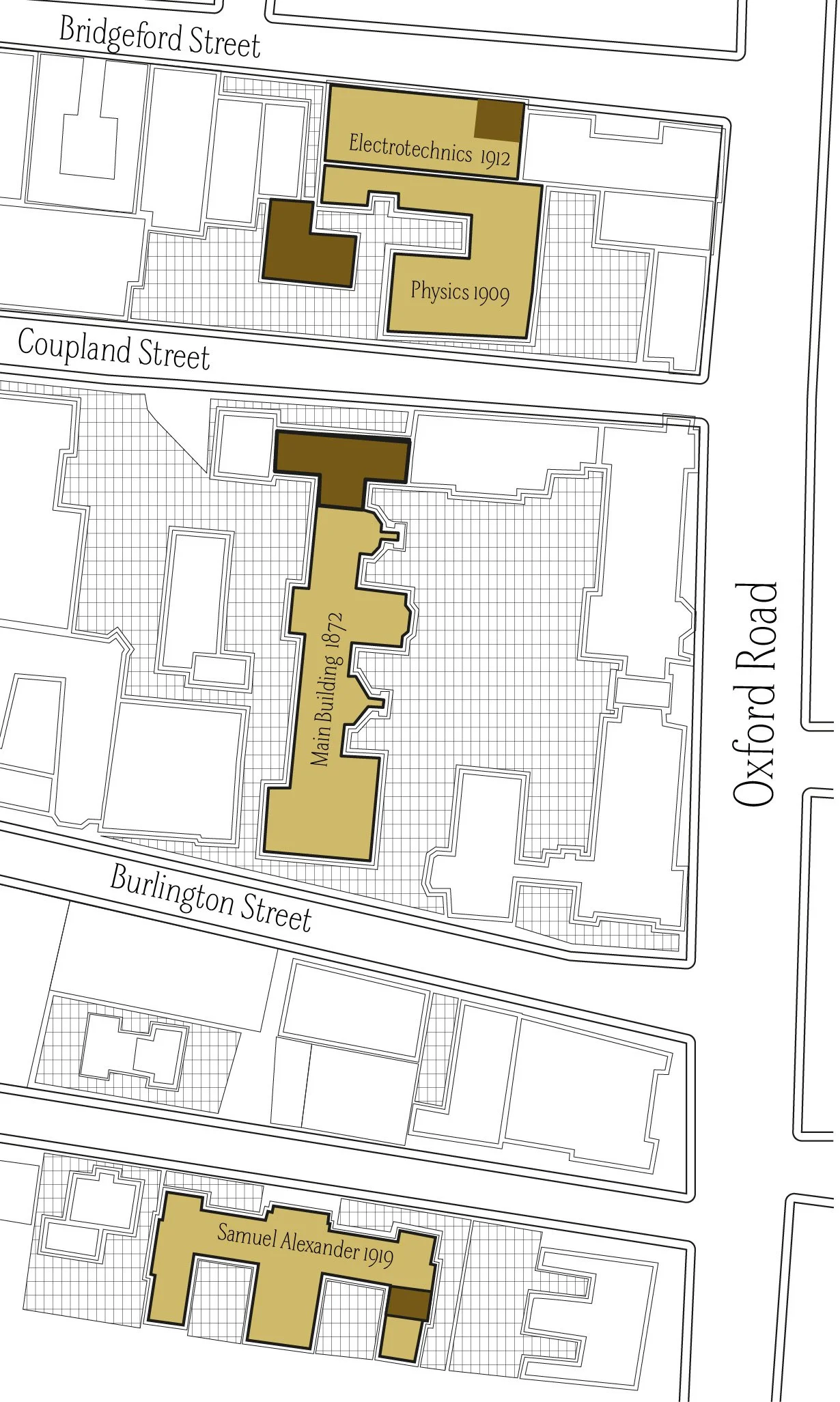
A map of the central Manchester University precincts around 1950. The four brown regions are, top to bottom,
the ‘lavatorial’ room where Williams and Kilburn’s 1948 ‘Baby’ prototyped the earliest practicable electronic memory bits, and in the process generated a plausible claim to run the worlds first computer programme.
the 1950/51 (?) Computing Laboratory, partly built with Max Newman’s £35000 Royal Society grant and the ‘little steel’ he extracted from a reluctant Ministry of (war) Supply. This housed both the successor to the Baby, the Manchester Mark I and its human labourers including individual offices for both Kilburn and Turing.
The offices of the mathematics Professor, on the top floor of the original Waterhouse lecture building
A lecture room in the Arts Building, possibly the site of the 1950 discussion on ‘Mind and the Computing Machine’ that seems to have provoked Turing into writing his Mind paper introducing the Turing Test.
None of these interiors are open to the public, though all can be clearly seen from public spaces. The University has in the past run walking tours that offer access, though they may have lapsed at the same time as the post of University Historian.
I post this partly because a publisher’s error has corrupted the map in the second printing of the book.
I drew this map and it specifically is freely copiable under a CC-BY copyright license (in fact I am happy to share the Adobe Illustrator files if you want to add anything). It is partly based on a 1926 booklet, The Victoria University of Manchester: a short historical and descriptive account; there is a copy of this in Universty of Manchester Special Collections. Aspects are mildly speculative, I should perhaps add offices for a (human) pre-war computer in the basement of the Christie Building and the wartime location of Hartree’s differential analyser in the basement of the 1909 Physics building. (It also seems a bit odd not to mention that building is where the atom got split.) Further references are in the book. The buildings south of Burlington Street have largely now disappeared.
Sometimes it is the People Paid to Imagine Stuff
Not for the first time I was asked the other day if Alan Turing had ever said the following quote:
Sometimes it is the people who no one imagines anything of who do the things that no one can imagine.
The answer is no, Alan Turing the historical figure is not on record as ever having said this, and he very probably never did. Benedict Cumberbatch, on the other hand, definitely did say it.
It doesn’t really matter much, but:
Both Andrew Hodges and Dermot Turing, the two of Alan Turing’s biographers I respect the most, have told me that they don’t recognise the quote from any primary source material.
The quote does appear in the 2014 film The Imitation Game. In fact it is said first to Turing by Christopher Morcom, Turing’s first love at school, and then repeated later in the film when Alan Turing (Cumberbatch) is asked by Joan Clarke (Keira Knightley) why he has singled her out for a key role at Bletchley Park. The Imitation Game is a Hollywood narrative, crafted to make emotional sense to audiences, in this case by making Turing more sympathetic through letting us see a paying forward of his debt of support from Morcom to Clarke.
The film certainly fictionalises very many aspects of the historical source material. Opinions have differed on how morally legitimate this fictionalisation was, but in any case it is overwhelmingly likely to me that this particular phrase was conceived in the mind of the script writer.
More broadly, Turing is drawn on today as a hero in a modern drive to offer inspiration to a more diverse set of students than he ever encountered in 1930s Cambridge. It might be worth remembering that Turing was as embedded in the sexist and classist assumptions of that time as much as anyone. If Turing did offer a helping hand in recruiting Joan Clarke (which I don’t think there is any evidence for) it was because she had a Cambridge First, and because he knew her brother from High Table…
By 2015, the quote was being discussed, as a quote from the movie in at least one blog. One comment on the blog suggested the line also appeared in Tim Burton’s 2010 Alice in Wonderland though the copies of that script I can find online don’t seem to contain the quote.
Sometime around 2019 I saw the following different quote in the wild, but credited again to Alan Turing
Those who can imagine anything, can create the impossible
Again, I don’t know of any primary historical source for this quote. Dermot Turing thinks that this one originated in the 2006 fiction A Madman Dreams of Turing Machines by Janna Levin. which I have not read. Unlike the first quote, which is so blandly banal that anyone could have said it, I think mathematical logicians are the one class of people who definitely would not write this second sentence. (I can though imagine a Max Newman exploding while a Ludwig Wittgenstein expounded this). I can imagine that it is meaningful, I suppose, but only by creating an impossibility. To be fair, there is no provably terminating algorithm to verify my claim.
Unfortunately, the place where I spotted this unsourced quote was.. the newly redecorated reception area of the Turing Building, home to the University of Manchester’s Department of Mathematics. How on earth it came to be installed I don’t know. At the time the University had a professional historian in place as University Historian, who might have enquired about the source, but he wasn’t consulted, and the University have since decided they don’t need such a post anyway.

Filming Dr Who in Manchester Town Hall
…never happened, as far as I know. But I think it will once the location scouts see this production still from the 1935 Manchester of Commerce handbook.
The photo is credited to GR Hinks. I’ve not been able to confirm the connection, but a Manchester engineer named George Ryder Hinks (1886-1949) might well be him in which case I think it comes out of copyright today 1 Jan 2020. Happy New Year!
