Skewed research

A previously unpublished Turing letter on number theory

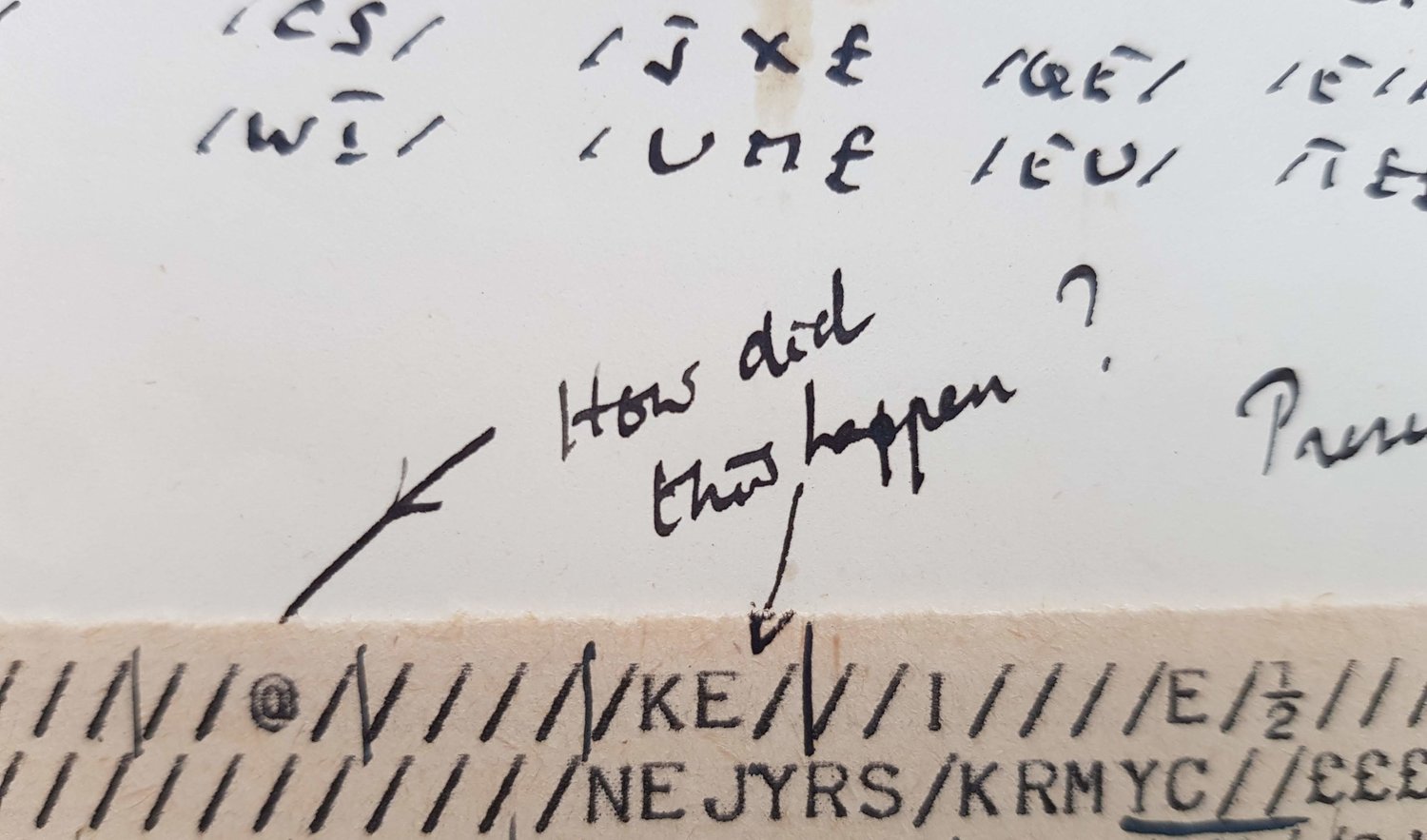
After I’d finished the research on Turing and was working on someone quite different I turned up a previously unpublished letter by Turing on number theory. For the record here it is.

The letter is in Trinity College Cambridge. Turing wrote it at home in Wilmslow to a Cambridge mathematician named Albert Ingham and it is undated though almost certainly written around Christmas 1951. That’s because it is a response to a letter Ingham wrote to Turing on 19 Dec 1950 and in turn it got a response on 2 Jan 1951: both of these letter’s are in King’s and online and they have been excellently put in context by Denis Hejhala and Andrew Odlyzko.  The letter has long been catalogued as from Turing in the printed Trinity catalogue for AE Ingham’s papers, but they’ve never put that catalogue online and the two sides of the correspondence have not been connected before. (It’s one of those libraries where research can tend to the serendipitous.) I don’t think the editors of Turing’s Collected Works knew about it.

I’m not going to comment on the details of the maths so as not to bore you. Also because I don’t understand them. The rough problem is estimating how big a number now called Skewes’ number is. That was a characteristically ambitious problem for Turing: it turns out that Skewes’ number is the largest interesting number in the universe. (**)

Like all of Turing’s writings this letter is copyright by King’s College. Although the copyright in Turing’s published work expires at the beginning of 2025 you will need their permission until 2039 to reproduce this unpublished material for non-fai…

Like all of Turing’s writings this letter is copyright by King’s College. Although the copyright in Turing’s published work expires at the beginning of 2025 you will need their permission until 2039 to reproduce this unpublished material for non-fair-use reasons. King’s are responsible and generous copyright holders and it’s not their fault that copyright law is quite badly broken.. I record my thanks to Trinity College Cambridge for allowing me to view this letter. and making it possible to reproduce.

ingham02.jpg

 (**) Skewes’ original bound was for the first sign change of the difference between the number of primes up to a point and a well known and very good approximation for that number given by a logarithmic integral. The characterisation of this crossing as happening at less than 1.397x10^316 was described by GH Hardy as requiring ‘the largest number that has ever served any definite purpose in mathematics’.  There have been a number of versions of Skewes’ number related to the behaviour of the Riemann zeta function and the distribution of primes. But actually a decently robust definition would be the largest interesting number which has ever appeared in any mathematical research not intended to define a largest interesting number. And before you all write, I am aware of the proof that all numbers are interesting, though personally I am bored of 1729. Stanley Skewes was a South African-born mathematician who was a contemporary of Alan Turing’s at King’s. As well as collecting a PhD in number theory  from Cambridge, Skewes also went home with a wife, Ena Allen, who Wikipedia tells us was a keen opera singer and the daughter of the head chef of King’s College. (Ancestry.co.uk suggests that Stanley already had a wife, Vera Rothkugel, in South Africa) Skewes pops up in the Turing timeline as a useful illustration of the mathematical culture at Cambridge in the 1930s: they used to row together in the King’s boat.  Years later Skewes was at pains, when having to communicate a slightly delicate point about the two of them working on the same area, to remind Turing of the connection. Stanley seems to have taught at the University of Cape Town until at least the 1970s: he wrote a reference for the young JM Coetzee.

Ingham himself was a mathematician rather in the mould of his contemporary Max Newman: a grammar school boy, son of a boot machine operator, for whom a Trinity scholarship and then high Tripos results were the making of a career. As Burkill wrote ‘In the early 1920’s young men who had escaped or survived the war found a market, favourable to both buyers and sellers, in appointments at Cambridge or Oxford and other Universities. G. H. Hardy had a large say in the placing of pure mathematicians.’ In 1930 Frank Ramsey had become a genius by dying early and Ingham came back from Leeds to take Ramsey’s old job at King’s where he stayed a Fellow for the rest of his life: he would probably have been Turing’s undergraduate supervisor. Norbert Wiener, who would later parlay a brilliance with Fourier transforms into a bestseller via the creation of cybernetics, and rarely missed a chance to make everything about himself, gave a rare acknowledgement of Ingham as an inspiration. I don’t know why Ingham’s papers ended up in Trinity rather than King’s but I suspect it reflects Ingham’s opinion of where the prestige lay in Cambridge mathematics.

Ena Skewes, second left, at the International Congress of Mathematicians in 1932. Mary Cartwright, later one of the first chaos theorists, is at the far righr. From Wikipedia

Ena Skewes, second left, at the International Congress of Mathematicians in 1932. Mary Cartwright, later one of the first chaos theorists, is at the far righr. From Wikipedia

If I walked that Way I'd get arrested: the birth of the Alan Turing Way

From a pamphlet marking the opening of the Alan Turing Way, 1994. From the archives of the Manchester Lit & Phil.

From a pamphlet marking the opening of the Alan Turing Way, 1994. From the archives of the Manchester Lit & Phil.

Thanks to the archivist at the Lit & Phil I can firm up the history of Manchester’s rediscovery of its Turing connection. The Lit & Phil staff got out their Turing file for when I visited to give a talk last month and it contained a small pamphlet anonymously created by the Central Library. The pamphlet marked the opening of the Alan Turing Way, by the City Council, on 12th December 1994.

It has a foreword by the then leader of the council, Graham Stringer, who mentions that he only came across the story of Turing the year before, in 1993.   But where did Stringer come across the story? There was mild publicity when Andrew Hodges’ biography came out in 1983,  and more when Hugh Whitemore’s dramatic adaptation Breaking the Code premiered in London in 1986 (I think, but am not sure I went and saw Derek Jacobi; it is mixed up in my memory with Tom Stoppard’s Arcadia which was ten years later, but the two were pretty much the only representations of mathematical culture I saw in the theatre up until the mid 90’s). That had a TV adaptation, but not until 1996. Possibly there was some extra press when the Vintage paperback edition of Hodges came out in 1992.

In any case I’d love to hear from anyone who knew of Turing’s Manchester connections before the road to the velodrome got built. I could ask Graham Stringer MP but he is busy being a climate change sceptic and Lexiteer so I am not inclined to give him much weight these days. (Postscript Dec 2019: I’ve had a helpful message from Mark Ovenden, one of the Council’s ‘Gay Men’s Policy Officers’ at the time, who confirmed my suspicion that Stringer himself had little to do with it, and that the idea emerged from the then Gay Men’s Subcommittee).

I have said in the past that the public marking of the Alan Turing Way only came after the privately-funded campaign that resulted in the Sackville Gardens statue. It turns out I was wrong: the archive also has a bunch of press cuttings about that campaign that make it plain that it didn’t start until five years later in 1999.

Minute Book of the Manchester Lit & Phil, 1954, with thanks to the Society for giving me access.

Minute Book of the Manchester Lit & Phil, 1954, with thanks to the Society for giving me access.

Not in the Lit & Phil’s Turing file, but in their Minute book, is the page recording Turing’s admission to membership. It only came in the last year of his life. Some of the other names on the page are notable (to me): Polanyi, Jefferson and Niel Pearson of the ‘51 society. I also note ‘Miss A Clayton’: it is perhaps just possible that is Audrey Bates, who was working for Ferranti and got married around this time and changed her name to Clayton, but that would require a rather unlikely mistake (and be surprising in my understanding of the Lit & Phil membership).  


The Tale of Two Plaques

One of the reasons I wrote Alan Turing’s Manchester was to make sense of the paradoxical way I heard Mancunians both take pride in the city’s role in Turing’s life and simultaneously condemn what happened to him when he was here. I attempted to sum this up in my final chapter, about the way in which Turing was cold-shouldered in the University’s computer department and forgotten and then reclaimed by its institutional memory. It’s the chapter of the book I am least happy with, but because because of that I’m going to post it here and see if it provokes any response.

I’ve removed the source references here but they can be found in the book itself. It assumes that you know that Max Newman and Patrick Blackett had together created a Calculating Laboratory to make and use an electronic computer in Manchester, and Freddie Williams and Tom Kilburn, were recruited to that laboratory as, later, was Alan Turing.

There are today two separate blue plaques on the same building complex off the Oxford Road, but you can’t see them both at the same time. There is one facing north shared by Williams and Kilburn, and after you take an inconvenient diversion around the Manchester Museum, there is one facing south for Turing, in a physical representation of a difference in viewpoint that has rumbled on ever since the events of 1948. Neither plaque says anything untrue but then again neither plaque mentions the other. They represent a history that portrays Kilburn and Williams as one type of thinker and Turing as another.

For most of the twentieth century, the history of Manchester computing simply started in 1948.  This said that Williams and Kilburn had been interested in the engineering challenge of making, rather than programming, a computer and that, it went, is what they succeeded in doing: ‘Freddie Williams was not, I think, interested in the computer as a computer. What we were interested in doing was creating the computer for other people to use’. In this account Newman’s computing project had been an unsuccessful rival to Williams’, an account helped by Newman’s own lack of credit-seeking behaviour.  When a historical Turing re-emerged after 1983, it was as a National Treasure residing at Manchester at the time but with no relation to the machine, except through using it for his impenetrable biological mathematics. In 1998 the Department of Computer Science held a 50th anniversary celebration to mark the first running of the Baby: Turing, it’s said, was not mentioned on the day, and in 2006 one leading local computer scientist said ‘Colossus was not a machine in the direct line leading to the modern computer’. This engineer’s history can’t be said to be wrong, but it is partial.

It wasn’t until the twenty-first century that the pre-Mark I history of the Manchester computers was quarried by revisionists aiming to re-establish the role of the mathematicians. They pointed out that, even years after the event, Williams had always been generous in acknowledging the mathematicians’ influence and had no difficulty recalling that Tom Kilburn and I knew nothing about computers…Professor Newman and Mr AM Turing knew a lot about computers. They took us by the hand and explained how numbers could live in houses with addresses. In 1948, it was as electronic engineers, not as computer architects, that Williams and Kilburn led the world.  Kilburn, by contrast, was much more grudging: ‘Between 1945 and 1947 somehow or other I knew what a digital computer was…where I got that knowledge from I’ve no idea’. In fact he had got it from attending a series of lectures: the lectures given by Turing. It’s unlikely that Kilburn in these later comments was deliberately obscuring credit due to Turing, and more plausible that he just didn’t remember owing anything to the mathematicians. As a young PhD student Kilburn was not interested in the past, and quite insulated from the administrative background. There is no patent on an idea, or on a funding decision, and rightly it was Kilburn listed as inventor on the computer memory patents, not Turing or Newman or Blackett.

The final glimpse we have of Kilburn and Turing working together is over a long summer night in June 1950. After the somewhat fake demonstration for the BBC of doing Mersenne mathematics on the Manchester Mark I there had been a year of work by Turing on an actual research problem. Turing had developed code to explore a pure mathematical axiom known as the Riemann Hypothesis, and that, together with some work on an optical problem, may have been all that the machine did for a year. Finally, in June 1950, the Riemann code ran successfully, all night: ‘The calculations had been planned some time in advance but had in fact to be carried out in great haste. If it had not been for the fact that the computer remained in serviceable condition for an unusually long period from 3 p.m. one afternoon to 8 a.m. the following morning it is probable that the calculations would never have been done at all’.  An engineer had to be on standby whenever the machine ran and it was Kilburn who stayed overnight with Turing and ensured the unusually long uptime. This was the first application of the Manchester computer to generate a mathematical paper, but it was also the time at which Kilburn began to realise that the aims of the Manchester logicians and (perhaps unknown to him) cryptographers were very different to those of the applied mathematicians using computing resource elsewhere in the world. Henceforth, he said, he would address the latter, and in doing this he chose a group of consumers with practical, well-funded, and plausible needs who would in fact drive the economic development of the computer for decades. It meant that Manchester computers would be used to do the large repetitive calculations needed by the atom bomb projects. This was the opposite use to the automated reasoning that Newman and Blackett had intended. Newman seems to have accepted this, though it took Manchester off a path pointing to intelligent machines. Blackett, on the other hand, was unhappy, perhaps because of his opposition to atomic weapons themselves.

But Blackett no longer had any leverage over the project. Though Kilburn and Turing worked together in the early days, they never collaborated in any intellectually meaningful way. Had they done so, the potential for an early breakthrough in artificial intelligence would have been enormous. They were two people of creativity and achievement, with much knowledge and background in common, and with different and complementary skills in a field ripe for innovation. But something about those differences kept them apart. They were both productive bees, but one looked like an ant and one a spider. This is a story where it is very tempting to align two men on opposite sides of an apparently intuitive divide. Asked to assign one member of each pair from: North/ South, Manchester/Cambridge, grammar school/public school, engineer/mathematician, applied/pure, doer/thinker, hardware/software, trade/gentry, earned/ entitled, patent holder/private thinker, the labels that apply to Kilburn/Turing might seem at first obvious and factual. Binary reductions are as addictive as they are misleading, so that adding into the list masculine/effeminate, straight/gay, legal/illegal might give hardly more pause for thought. It is a short step, then, to a conclusion that manly Manchester’s judgement of Turing as an effeminate Cambridge criminal led to ostracism and Turing’s depression and suicide. But it is a simplistic step without direct evidence. There is clear evidence that there was coldness. Perhaps it was the engineers that felt looked down on: some of the mathematicians considered Williams and Kilburn as not ‘ideas men’.  Williams later gave a lecture, Engineering Must Not Degenerate Into Mathematics, which under cover of a successfully jocular tone revealed a distinct bitterness about the class distinctions in the ‘traditional aristocratic attitude: to be really tops two things are required: (a) one must be supremely good at something. (b) The something at which one is supremely good must be absolutely useless’.  It was more than class, though. Kilburn and Turing are recorded by multiple sources as not getting on, and Geoff Tootill, in long hindsight, speculated that this was because Kilburn knew of Turing’s sexuality. But after this the binaries start to fray. Tootill also thought there may have been disapproval of Turing’s general untidiness and tendency for his underpants to show above his trousers, and another programmer thought Kilburn in general liberal and broadminded.  The dichotomies don’t always survive inspection: Kilburn had had a Cambridge mathematics education too, and Turing also came to Manchester through choice and with hands-on electronic expertise. And though to begin with Turing was paid more than Kilburn, by 1954 Kilburn’s career prospects and consulting fees were rapidly improving. There may have been a ‘jagged rift’ between the engineers and the mathematicians, but it was perhaps more a silence of incomprehension than anything more destructive.

121 CB4 kilburn slots 334423447_c95792b4f0.jpg
120 turing building 20181114_135012.jpg

One heir on the programming side wrote: ‘Turing, Kilburn, and Williams, were all three quite different people… stars of the scientific establishment to my mind…good, kind people’. Whatever the reasons, Manchester’s Electrical Engineering department, and the Computer Science department that succeeded it on the Oxford Road, became a place where people made computers more than one where they used them. The place of the Manchester Mark I in the history of computer development is secured far more by its hardware than by its software. The histories of the '50s and '60s are histories of ground-breaking machines more than of programs. In hindsight, that may have been a poor long-term bet. For a few decades Moston and then Gorton were the sites of factories that made mainframe computers; meetings of the Lit & Phil can still attract the men and women who made them. But the engineers who can say they have built computers in Manchester are all now retired. Although the Ferranti Mark I had the largest share of the new market, British hardware rapidly started to lose out to American machines on reliability and cost. Within a few years of the delivery of the Ferranti Mark I to AWRE, the British atom bomb designers were demanding an IBM replacement, not a British one, and certainly not Kilburn’s Atlas. Large, centralised computing facilities based around IBM hardware did evolve locally, and in the 1950s and 1960s Shell, Barclays and the TSB all set up large new centres in Wythenshawe. Today computing power has become a commodity, provided by huge server farms who choose not to advertise their physical location, and if Manchester is still a significant provider of information processing capacity to the UK we have no accurate way of knowing: in any case the industrial estates of Manchester no longer make computers, or even disk drives.  

But Manchester is still visibly home to a thriving, if small, software industry, though the Kilburn building still, to the surprise of some newcomers, makes little of the connection between the Computer Science Department and Turing as local hero and founder of Computer Science. The red brick building, glazed with narrow slits in a 1970s version of housing for machine acolytes, sits across a bare plaza from a more transparent glass and steel Mathematics building which is named after Alan Turing. When the mathematicians planning that twenty-first century development had warily enquired if Computer Science had any major developments they wanted to name after Turing, the mathematicians were emphatically told that if Turing had lived longer he would have set back computer science by decades and that the mathematicians were welcome to him. And so they are.